
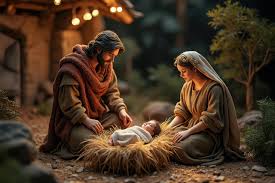
CHRISTMAS: Homily on Matthew 1:1-25
I. There was once a little boy who loved crafting things with his hands. One day, he decided to make a small wooden boat. He worked on it for days, carefully carving, sanding, and painting it. When it was finally done, it was perfect in his eyes. He took it to the nearby stream, where he watched it float gracefully on the water.
But suddenly, a strong current pulled the boat away. The boy chased after it, but it was gone. He returned home heartbroken. Days later, while walking in the market, he saw his boat in a shop window. His heart leaped with joy, but when he told the shopkeeper it was his, the shopkeeper said, “If you want it, you’ll have to buy it.” Determined to get it back, the boy worked hard, saved up his money, and finally bought his boat. Holding it close to his chest, he whispered, “Now you are mine twice, first because I made you, and now because I bought you back.”
This simple story reflects the deeper mystery of Christmas. In today’s Gospel, Matthew tells us about Jesus’ family tree, beginning with Abraham and leading to Joseph, the husband of Mary. At first glance, it seems like just a list of names, but if we pause, we see something extraordinary. This genealogy includes kings and peasants, saints and sinners, and even those whose lives were full of brokenness. Yet God worked through all of them to prepare for the coming of His Son.
One name in this passage stands out: “Emmanuel,” which means “God is with us.” This name reveals the essence of Christmas. Like the boy who lovingly made his boat, God created us in His image, with great care and love. But through sin, we drifted away from Him. Yet God never gave up on us. He didn’t wait for us to find our way back. Instead, He came into our world, into our lives, to bring us back to Himself.
Imagine the humility of God becoming one of us. Jesus, the Creator of the universe, chose to be born in a simple manger, surrounded by shepherds and animals. Why? Because He wanted to meet us where we are; in our joys and sorrows, our hopes and fears. He came not for the perfect but for the broken, not for the righteous but for sinners.
This Christmas, let us reflect on what does it mean to say “God is with us.” It means that God’s love is not distant or conditional. He is with us when life is beautiful and when it is messy. He is with us in our moments of faith and even in our moments of doubt. His love is constant, unchanging, and personal.
Like the boy who reclaimed his boat, God has made us His twice: first in creation and then in redemption. Through Jesus, we are brought back into His loving arms, not because we deserve it, but because His love for us is beyond measure.
So, as we celebrate the birth of Jesus, let us open our hearts to Emmanuel, the God who is with us. Let us welcome Him into our homes, our families, and our lives. And let us share this good news with others, so very one can experience the joy of being held by the One who made them and redeemed them.
This is the true meaning of Christmas: the God who is with us, now and always. Amen.
II. Christmas Homily: God’s Light in Our Midnight
There’s a story told about a small village settled deep in the mountains. Every year during the harsh winter, the villagers would light a single light in their church and hang it from the tallest tree in the square. It wasn’t grand or impressive, but it was enough to guide travellers lost in the darkness of the snowy hills. For many, that humble lamp meant the difference between life and death. One year, a storm was so aggressive that the village itself lost power. In complete darkness, the people gather together in fear. Yet, as one child peered out the window, she whispered, “The lamp is still there.” Its light broke through the storm, reminding everyone that even in the darkest night, light can lead us home.
Christmas is the story of such a light breaking into our darkness. The Gospel of Matthew (1:1-25) recounts the genealogy of Jesus, showing us that His coming was not random but part of God’s grand design. It tells of the angel’s words to Joseph: “They shall name Him Emmanuel, which means ‘God is with us.’” And this truth, that God is with us, is at the heart of Christmas.
But have we ever wondered why God chose to send His Son at midnight? Not at dawn, when the world is waking, or at noon, when light is strongest, but at midnight, when the world was asleep, and darkness seemed to reign. God’s choice was not accidental. Midnight symbolises the moments in our lives when we feel lost, forgotten, or overwhelmed. It’s the space where questions seem louder than answers and where hope feels faint.
Yet, it was into this very darkness that God planted His greatest gift. He came not in a palace surrounded by wealth but in a humble manger, announced to shepherds, ordinary, overlooked people. This is the paradox of Christmas: God didn’t wait for the world to be ready. He didn’t come in strength but in vulnerability, as a baby needing to be cradled. The Creator of the universe became part of His creation. The Author of life became speechless before He could speak. He showed us that true power often looks like humility, and true light shines brightest in the darkest moments.
Perhaps we are in our own midnight this Christmas. Maybe one feels overwhelmed by the storms of life or burdened by uncertainty. But remember, midnight was the time God chose. The shepherds did not need to change who they were to hear God’s message. The stable did not need to be cleaned or turned into a palace to welcome the Saviour. And one does not need to have everything figured out to meet Him.
This Christmas, let us not wait for perfect circumstances to celebrate. Let us recognise that just as the lamp guided travellers in the dark, Christ is the light that guides us home. Let us bring our struggles, our doubts, and even our brokenness to the manger, trusting that God can use them as the birthplace of something new.
May this holy season remind us that our darkest midnights are not the end. They are often the sacred moments when God draws closest, planting seeds of hope, peace, and joy in our hearts. Let us dare to believe that in the cry of a child in Bethlehem, God has whispered to the world: “I am with you, now and always.”
Happy Christmas, and may the light of Christ shine brightly in your hearts and homes this season and always.
III.Christmas Day Message: Restoring Christ to Christmas
One day, someone asked a group of children, “What is Christmas?” A boy quickly replied, “It’s Santa Claus’s birthday!” A girl disagreed, saying, “No, it’s the festival of stars.” Others chimed in, saying it was about lights, decorations, and gifts. Sadly, none of them mentioned Jesus or His birth.
This is not just about children. Look around during Christmas, and you will see how far we have drifted from its true meaning. Even a simple search for Christmas greeting cards online reveals this shift. Unless you specifically look for cards featuring Jesus, Mary, or the Holy Family, most results will show Santa Claus, reindeer, snowmen, or glittering decorations. For many, Christmas has become a celebration of everything except Christ.
But Christmas is not about Santa, trees, or lights. It is the celebration of Jesus’ birth. It is the moment when God became one of us, not as a king in splendour but as a humble baby in a manger. It is a time of hope, light, and God’s incredible love for humanity. The miracle of Christmas is that the Creator of the world chose to live among us, bringing light to our darkness, peace to our hearts, and the assurance of His abiding presence with us.
The Gospel of Matthew (1:1-25) reminds us of the true meaning of Christmas. It traces the lineage of Jesus, showing how God fulfilled His promises through generations, and recounts the miraculous events leading to His birth. It is here that we hear the angel tell Joseph, “They shall name Him Emmanuel, which means ‘God is with us.’” This name reveals the profound mystery of Christmas: the Creator of the universe chose to become one of us, not as a mighty king but as a humble child. He entered our broken world to bring us hope, peace, and the assurance of His unshakable presence.
As we celebrate this sacred day, let us restore Christ to Christmas. Teach children that this is the birthday of Jesus, who came to save us. Let our decorations and celebrations reflect His story, the star that led the way, the manger that held Him, and the love that embraced the world. Let us live the message of Emmanuel by reaching out to those in need, comforting the lonely, and sharing the joy of Christ’s birth with everyone we meet.
Christmas is a reminder that we are never alone. Emmanuel, “God is with us,” means He is with us in our joys and sorrows, our successes and struggles. He is with us in every moment, offering His love and peace. This truth transforms Christmas from just a holiday into a holy day, a celebration of God’s boundless love and the hope that comes from knowing He walks with us always.
Today, as we celebrate the birth of Emmanuel, may the light of Christ’s birth shine in our hearts and homes. Let us thank God for the gift of His Son and share His love with the world. May this Christmas remind us of Emmanuel, God is always with us, who brings light to our darkness and joy to our lives.
Wishing you and your loved ones a Christmas filled with the love, peace, and presence of Christ. May Emmanuel, bless you today and always.
I like what you guys tend to be up too. This sort of clever work and reporting! Keep up the wonderful works guys I’ve included you guys to our blogroll.
This is a topic that is near to my heart… Thank you! Exactly where are your contact details though?
I am sure this article has touched all the internet users, its really really nice piece of writing on building up new blog.
I wanted to thank you for this excellent read!! I certainly enjoyed every bit of it. I have got you book marked to look at new things you
Ahaa, its pleasant discussion about this piece of writing here at this webpage, I have read all that, so at this time me also commenting at this place.
It’s very effortless to find out any matter on web as compared to textbooks, as I found this paragraph at this web page.
If you desire to take a great deal from this piece of writing then you have to apply such techniques to your won blog.
Hi, I do think this is a great site. I stumbledupon it ; ) I will revisit yet again since i have book marked it. Money and freedom is the best way to change, may you be rich and continue to help others.
I like what you guys tend to be up too. This type of clever work and reporting! Keep up the great works guys I’ve added you guys to my own blogroll.
Quality articles is the main to be a focus for the visitors to pay a quick visit the web page, that’s what this web site is providing.
I am sure this paragraph has touched all the internet people, its really really good article on building up new weblog.
Thanks for some other informative site. The place else could I am getting that kind of info written in such an ideal method? I have a venture that I’m just now running on, and I’ve been at the look out for such info.
I enjoy what you guys are up too. This sort of clever work and reporting! Keep up the good works guys I’ve incorporated you guys to my personal blogroll.
Heya i am for the primary time here. I came across this board and I in finding It really useful & it helped me out much. I am hoping to present something back and aid others such as you aided me.
I am sure this piece of writing has touched all the internet users, its really really nice piece of writing on building up new blog.
Thank you for the auspicious writeup. It in fact was a amusement account it. Look advanced to more added agreeable from you! By the way, how can we communicate?
Everyone loves what you guys are usually up too. Such clever work and exposure! Keep up the superb works guys I’ve added you guys to my own blogroll.
These are truly wonderful ideas in concerning blogging. You have touched some fastidious points here. Any way keep up wrinting.
Ahaa, its fastidious dialogue concerning this article at this place at this webpage, I have read all that, so now me also commenting at this place.
I’ll right away take hold of your rss as I can not find your email subscription hyperlink or newsletter service. Do you have any? Please allow me understand so that I may subscribe. Thanks.
I like it whenever people come together and share ideas. Great blog, continue the good work!
Keep up the fantastic work, I read few blog posts on this website and I believe that your web site is real interesting and contains bands of fantastic information.
It’s very trouble-free to find out any matter on web as compared to textbooks, as I found this paragraph at this web site.
Ahaa, its good conversation concerning this piece of writing at this place at this webpage, I have read all that, so at this time me also commenting here.
Wow, this piece of writing is good, my younger sister is analyzing these kinds of things, thus I am going to convey her.
Hi, I do think this is a great website. I stumbledupon it 😉 I will revisit once again since i have bookmarked it. Money and freedom is the best way to change, may you be rich and continue to guide other people.